Table of Contents
- Why Coaching Session Documentation Matters for Your Practice
- What to Include in a Coaching Session Notes Template
- Coaching Session Documentation Examples: Good vs. Poor Notes
- How to Track Coaching Progress Between Sessions
- Confidentiality, Consent, and Data Retention in Coaching Documentation
- Choosing Coaching Documentation Software That Fits Your Workflow
- Common Mistakes to Avoid in Coaching Session Documentation
- Frequently Asked Questions
Last Updated: October 16, 2026
Why Coaching Session Documentation Matters for Your Practice
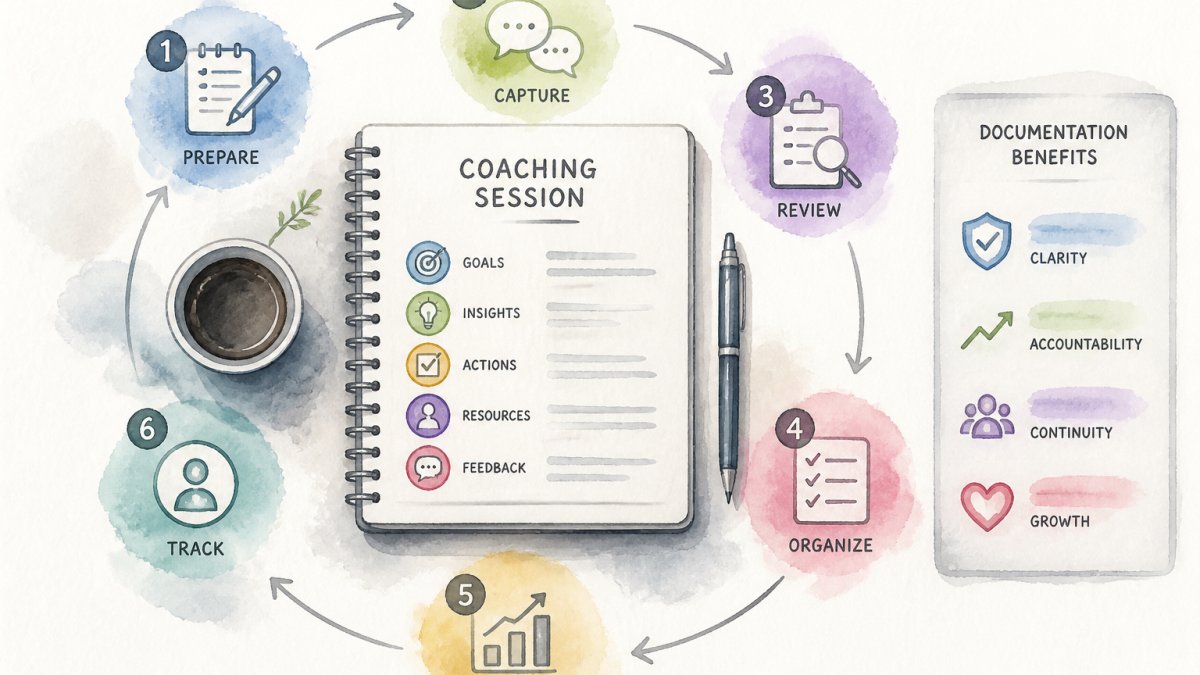
Coaching session documentation is the written record of a coaching conversation: the goals discussed, obstacles raised, actions agreed, and follow-up that comes next.
Documentation isn't admin, it's the memory of your practice.
Good records also protect you.
Below: a template you can copy today, real examples of strong and weak notes, and the privacy habits that keep your records safe.
What to Include in a Coaching Session Notes Template
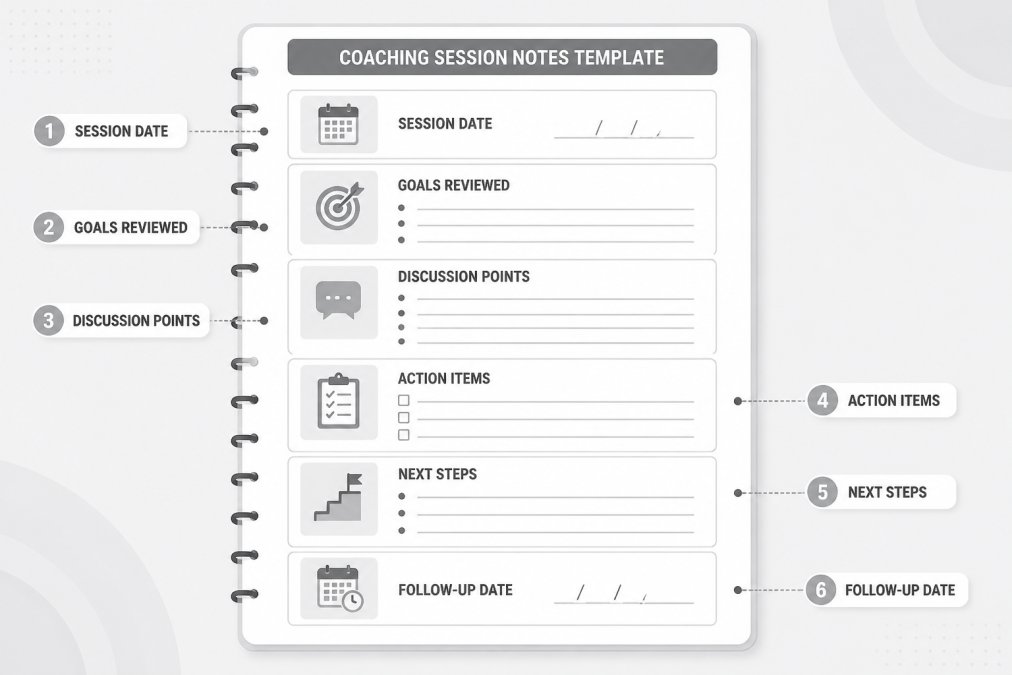
A coaching session notes template needs six core elements: session date, goals reviewed, key discussion points, agreed action items, next steps, and the follow-up date. Keep the structure fixed and the content takes care of itself. Here's what belongs in each field:
- Session date and number so you can trace a client's arc over months. Write
2026-10-16 | Session 7, not "last Thursday." - Goals reviewed to reconnect with what the client wanted last time. Quote them: "I want to stop dreading Mondays," not "improve work satisfaction."
- Discussion points in the client's own language, not your interpretation. Two to four bullets is plenty.
- Action items with an owner and a rough timeframe, what, who, and by when. "Client will draft the agenda by Thursday" is complete. "Client will work on agenda" is not.
- Next steps so the client leaves knowing what happens next, one sentence, not a to-do list.
What most guides miss is the difference between an observation and an interpretation. "Client arrived ten minutes late" is an observation; "client is disengaged" is an interpretation and doesn't belong in a professional record. Write what you saw and heard.
A Simple Template You Can Copy Today
Use this structure for every session. It takes three minutes and saves far more in recall.
Session Notes: [Client Name] | [Date] | Session [#]
Goals reviewed: [Restate the client's goal in their words] What we discussed: [2-4 bullet points, factual and specific] What the client noticed: [Any insight, shift, or concern they raised] Action items: [Action | Owner | By when] Next session focus: [One sentence] Follow-up: [Date and method]
Annotated Example: What Good Looks Like in Each Field
Here's the same session written two ways. The left column is what a rushed coach writes. The right column is what actually helps six weeks later.
| Field | Weak entry | Strong entry |
|---|---|---|
| Goals reviewed | "Confidence goal." | "Client's goal: lead one team meeting without notes by end of month." |
| What we discussed | "Talked about the meeting." | "- Client mapped the three points they want to make\n- Worried about losing their place mid-sentence\n- Agreed to practise with a colleague first" |
| What the client noticed | "Had a realisation." | "Client said: 'I don't actually need to be perfect, I just need to be clear.'" |
| Action items | "Practise more." | "Draft the three points and send to coach by Thursday. Practise once with colleague before Friday's meeting." |
| Next session focus | "Follow up." | "Review how Friday's meeting felt and what the client would change." |
| Follow-up | "Check in." | "Email Thursday to review draft; full debrief in Session 8." |
The strong column does three things the weak one doesn't: it uses the client's own words, names a date, and removes your judgement about the client's character. If you want to note a pattern, note the behaviour that made you think it.
What to Leave Out
A template is as much about what you don't record as what you do. Leave out:
- Diagnoses or clinical language you're not qualified to use
- Speculation about the client's motives, relationships, or mental state
- Anything a third party said about the client that the client hasn't heard
- Personal details that aren't relevant to the coaching work
If you're unsure whether something belongs, ask: would I be comfortable if the client read this back to me? If not, it doesn't go in.
Coaching Session Documentation Examples: Good vs. Poor Notes
The fastest way to improve your notes is to see a weak version beside a strong one.
| Element | Poor Note | Strong Note |
|---|---|---|
| Observation | "Client seemed unmotivated." | "Client said they skipped two planned practice sessions this week." |
| Goal | "Working on confidence." | "Client wants to lead one team meeting without notes by month end." |
| Action item | "Client will try harder." | "Client will draft the agenda for Friday's meeting and send it to me Thursday." |
| Follow-up | "Check in soon." | "Check in by email Thursday, review agenda in next session." |
Notice what the strong column does: it records facts the client could verify, names a deadline, and removes your judgement about the client's character.
A common mistake is writing notes as a summary of your own performance. "I asked strong open questions today" tells you nothing useful next month.
How to Track Coaching Progress Between Sessions
Tracking progress between sessions means choosing two or three indicators at the start of an engagement, recording a baseline, and reviewing the same indicators at every check-in. Consistency matters more than sophistication.
Here's a simple process:
- Pick your indicators with the client, not for them. Ask what would prove this is working.
- Record a baseline in the first session so you have something to compare against.
- Review at every session using the same question each time.
- Note movement, not judgement. "Client reported three of five planned actions completed" beats "good week."
- Flag stalls early. If an indicator hasn't moved in three sessions, that's a discussion point, not a failure.
Choosing Progress Indicators That Actually Show Change
Good progress indicators are observable, repeatable, and owned by the client. "Number of conversations initiated" works. "Feeling better" doesn't, because neither of you can verify it.
Confidentiality, Consent, and Data Retention in Coaching Documentation
Confidentiality, consent, and retention are the three rules that keep your documentation defensible. Explain all three to every client before the first session, in writing.
Start with consent. Tell clients what you record, where it lives, who can see it, and how long you keep it.
On retention, decide a review period and stick to it. If you work across borders, check the data protection rules that apply where your client sits, such as the ICO guidance on data protection for UK-based clients.
Access control is the last piece. If your notes live in a shared drive, assume someone else will read them.
What to Document in Different Coaching Contexts
This is the part most guides skip. The same note-taking habits don't fit every setting, and getting the context wrong is how coaches either over-share or under-record.
Life and personal coaching. The client is usually the only stakeholder, so you can record more freely, but the sensitivity is often higher.
A quick rule of thumb across all three: record what the client would recognise as true, and leave out what they'd be surprised to see written down.
A Simple Consent and Retention Checklist
Before your first session with any client, walk through these five points and get a yes on each:
- What you record, session notes, action items, progress indicators, and nothing else unless agreed.
- Where it lives, the specific tool or folder, not "securely."
- Who can see it, you, and anyone else named in writing.
- How long you keep it, a number, not "as long as needed."
- How the client can access or correct it, a simple process, offered proactively.
If a client asks to see their notes, say yes. Refusing is the fastest way to lose trust, and in many jurisdictions the client has a legal right to access anyway.
Choosing Coaching Documentation Software That Fits Your Workflow
Choose coaching documentation software by matching it to how you already work, not to the longest feature list.
Ask these questions before you commit:
- Can you write a session note in under five minutes on a phone?
- Can you search a client's full history for a single theme?
- Can you export everything if you leave the platform?
- Does it handle consent records and retention dates?
- Will your clients actually use any portal it offers?
That last question matters more than vendors admit. Coaches consistently tell us this is the first portal their clients have actually opened twice.
If you're weighing options, look at the Information Commissioner's Office guidance on choosing suppliers for questions to ask about data handling before you hand over client notes.
Common Mistakes to Avoid in Coaching Session Documentation
The same five mistakes show up in coaching records again and again. Each is easy to fix once you spot it.
- Writing judgements instead of observations. "Client is resistant" is a conclusion. "Client declined two suggested actions" is a record.
- Leaving action items without owners or dates. A task with no deadline is a wish.
- Documenting in a different place every week. Scattered notes can't show progress.
- Sharing more than was agreed. If the manager sees a raw note, trust is gone.
- Never reviewing the record. Notes you don't reread are just storage.
Here's the fix for all five in one habit: before each session, spend two minutes rereading the last note.
If your coaching work connects to reader or community engagement, the same principle applies: the Chartered Institute of Personnel and Development's guidance on coaching makes the point that structured reflection is what separates coaching from a friendly chat.
Coaching records are only as good as the follow-through behind them, and follow-through is where most practices quietly lose momentum.
Frequently Asked Questions
What should you include in coaching session notes?
Effective coaching session notes cover the session date, coaching goals reviewed, key discussion points, action items, agreed next steps, and a follow-up date. Include specific observations rather than interpretations, and note any obstacles the client raised. A consistent structure means you can review progress over time without hunting through scattered files. Aim for enough detail that someone unfamiliar with the session could understand what was agreed and what happens next.
How detailed should coaching session notes be?
Detailed enough to recall the session's substance, but not a verbatim transcript. Capture decisions, commitments, and notable shifts in thinking. Write observations separately from your interpretations. For example, note that a client postponed a task twice rather than writing that they lack motivation. This keeps your coaching session documentation objective and useful for spotting patterns across weeks, not just recording what happened.
How can coaches track client progress between sessions?
Use consistent progress indicators set at the start of the engagement. Review action items from the previous session at the top of each meeting, and rate movement toward desired outcomes on a simple scale. A coaching log that links each session to specific milestones makes patterns visible. When you track coaching progress this way, you can adjust your approach based on evidence rather than memory.
How should coaches protect the confidentiality of session notes?
Store notes in a secure, access-controlled system rather than shared drives or personal email. Tell clients at the start what you record, why, and who can see it. Set a retention period and delete notes when it passes. If you use coaching documentation software, check that it supports export and deletion so your client data is not locked in. Consent and transparency build trust and protect both parties.
What is the best way to organize coaching notes?
Organize by client, then chronologically within each client file. Use a consistent template so every session captures the same categories: goals, discussion points, action items, and next steps. Tag notes with themes like leadership development or accountability so you can find patterns later. Digital tools with search make this far easier than paper files, especially once you have months of sessions to review.
What are common mistakes to avoid when documenting coaching sessions?
The most common mistakes are writing subjective judgments instead of observations, skipping documentation after busy sessions, and storing notes without any access controls. Another is failing to review previous notes before the next session, which breaks continuity. Also avoid recording sensitive disclosures you do not need. Keep notes factual, consistent, and secure, and your coaching session documentation will serve you and your clients well.